If you’ve ever seen a tattoo that made you double-check whether you were looking at a photograph or a person’s skin, you’ve seen black and grey realism at its finest. It is one of tattooing’s most technically demanding disciplines — and one of its most breathtaking when executed well.
This guide explains what black and grey realism tattooing is, where it comes from, how it works, and what it takes to master it.
Defining Black and Grey Realism
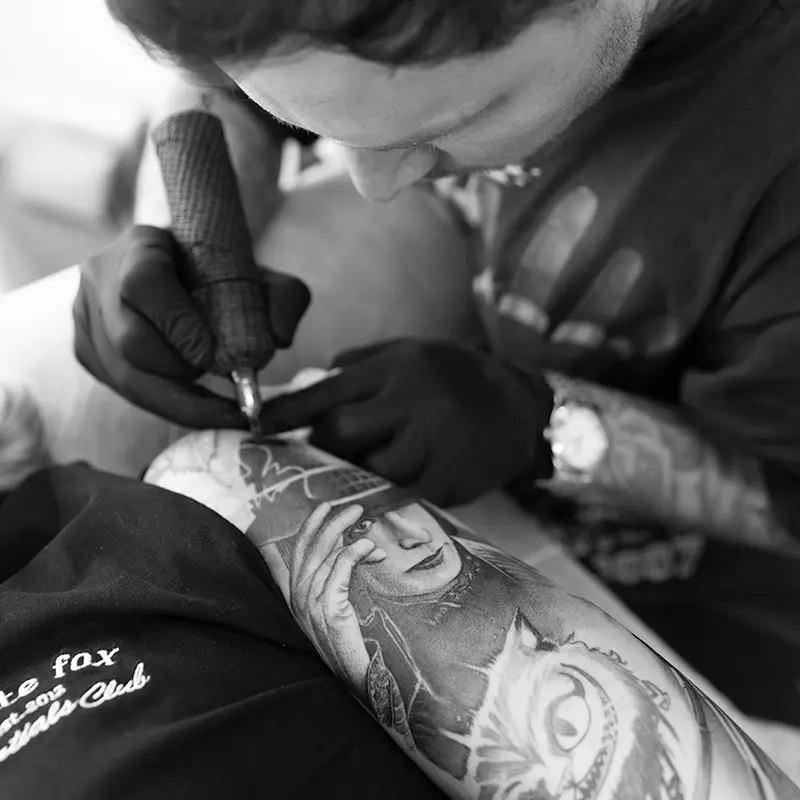
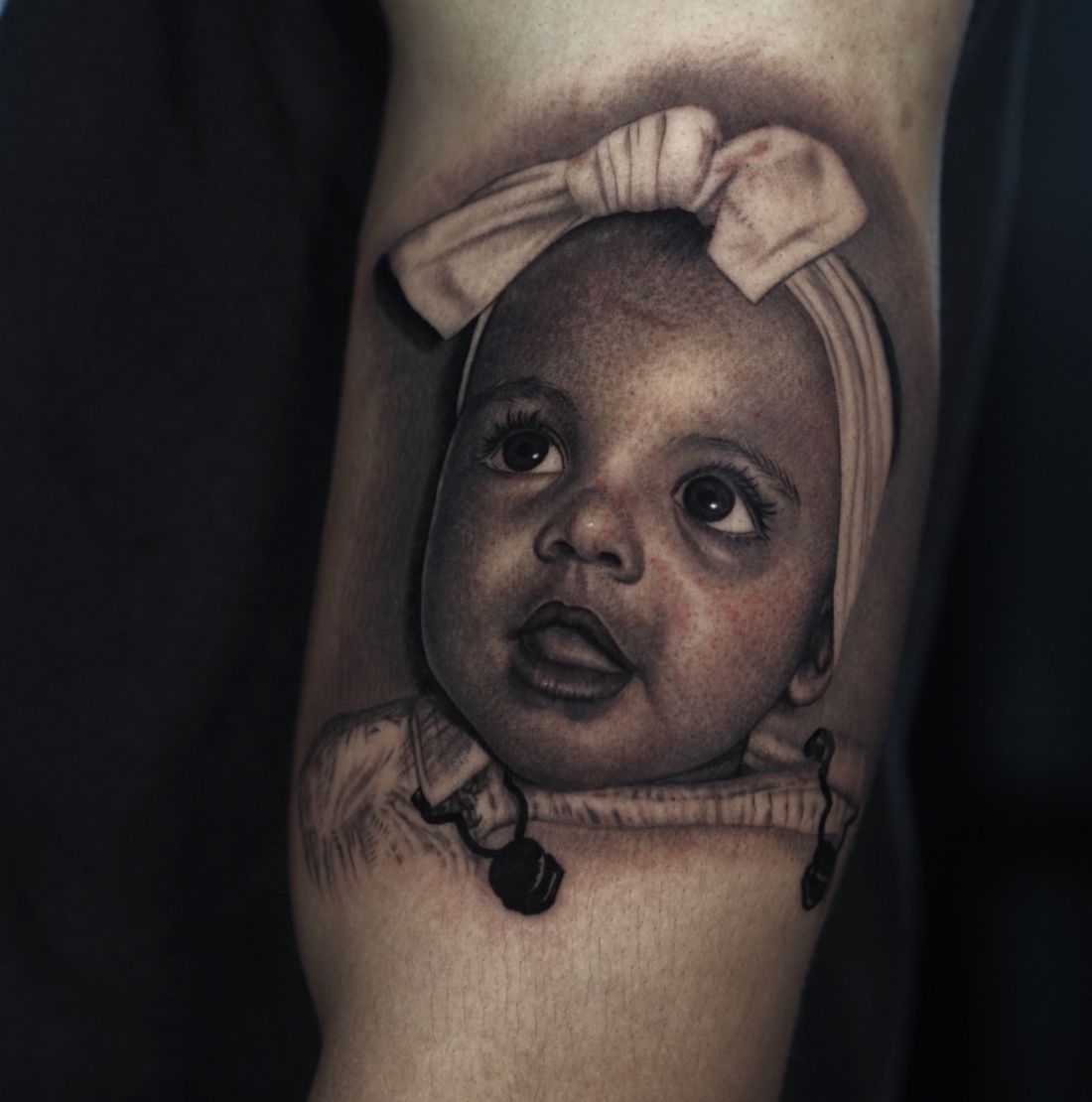
Black and grey realism is a tattooing style that aims to reproduce subjects with photographic or hyperrealistic accuracy, using only black ink diluted to varying greys, without colour. The defining characteristic is three-dimensionality: shading gradients, texture, and tonal contrast combine to create the illusion of depth and light on a two-dimensional skin surface.
The style is most commonly applied to portraits — human faces and figures — but extends into animal subjects, nature scenes, architectural details, fantasy imagery, and religious iconography. The subject matter almost doesn’t matter; what defines black and grey realism is the commitment to reproducing it faithfully.
Unlike illustrative or neo-traditional tattooing, there are no outlines in classic realism. Edges are defined by contrast — light against dark, texture against smooth — which requires far greater control over ink saturation and needle technique than outlined styles.
A Brief History of the Style
Black and grey tattooing has roots in American prison culture of the 1970s and 1980s, where artists worked with whatever materials were available — often a single ink and improvised needles. The constraint of monochrome forced the development of sophisticated shading techniques that became the foundation of the modern realism style.
The style was later adopted and refined by artists in the Chicano tattoo tradition, particularly in California, where it became associated with elaborate religious and memorial imagery. From there, it moved into mainstream studio work during the 1990s and 2000s, when artists began pushing the technique toward genuine photorealism.
Today, black and grey realism is recognised as one of tattooing’s most prestigious specialisations. Artists who master it are among the most sought-after in the industry, and their work commands some of the highest prices per session.
Core Techniques That Define the Style
Producing convincing realism on skin requires a fundamentally different approach to technique compared to most other tattoo styles:
Ink wash and dilution: Rather than using a single black, realism artists work with black ink diluted to multiple grey tones. Managing this palette — knowing which dilution to reach for at each stage of a piece — is one of the primary skills a realism artist must develop.
Needle configuration: Curved magnums (also called ‘soft mags’) are the workhorse needle for realism shading. Their curved arrangement allows them to move across skin more smoothly than flat configurations, reducing trauma and producing smoother gradients. Round shaders and liners serve specific roles in detail work.
Layering: Realism is built up in layers over a single session. Artists typically establish the darkest tones first, then work progressively through midtones to highlights. Rushing this process or overworking the skin are common errors that compromise the final result.
Stencil preparation: The quality of a realism tattoo is partly determined before the needle touches skin. Translating a reference image into a stencil that captures tone mapping accurately — knowing where the darkest and lightest areas fall — is a skill in itself.
Subjects Best Suited to Black and Grey Realism
While technically any subject can be rendered in a realist style, certain subjects recur because they produce the most striking results and best demonstrate the technique’s capabilities:
Portraits: Human faces — celebrities, loved ones, memorial portraits — are the hallmark of realism tattooing. A well-executed portrait requires the artist to reproduce likeness, emotion, and three-dimensionality simultaneously.
Animals and wildlife: Fur, feathers, and scales each present unique textural challenges that reward technical mastery. Wildlife subjects — lions, wolves, eagles — have consistent demand across demographics.
Religious and spiritual imagery: The realism tradition has deep roots in religious iconography. Christ portraits, rosaries, angel figures, and sacred heart imagery remain perennially in demand.
Fantasy, mythology, and dark art: Skulls, demons, biomechanical imagery, and mythological figures lend themselves particularly well to the drama possible in high-contrast black and grey work.
Why Mastering Realism Opens Up Premium Markets
Realism artists typically occupy the premium end of the tattoo market. Portraits and detailed compositions take long sessions to complete, command high hourly rates, and attract clients who’ve researched their artist carefully and value quality over cost.
This also means clients come prepared, provide clear reference material, and tend to be low-friction to work with. The realism client demographic is often older and more financially established than the average tattoo client — which translates to consistent high-value bookings.
The flip side is that the technical barrier to entry is high. Artists who produce realism work with soft edges, muddy midtones, or inaccurate likeness will not retain these clients. Quality is non-negotiable in this market.
Is Black and Grey Realism Right for You?
Realism rewards artists who are drawn to technical challenges and find satisfaction in precision. If you’re the kind of person who obsesses over details, studies how light falls on surfaces, and is willing to put in the hours of practice on synthetic skin before working on clients — realism is likely a natural fit.
It’s also worth noting that black and grey skills transfer. Many techniques used in realism — layering, wash work, tonal management — inform fine line work, portraiture, and even illustrative styles. Realism training raises your technical floor across the board.